
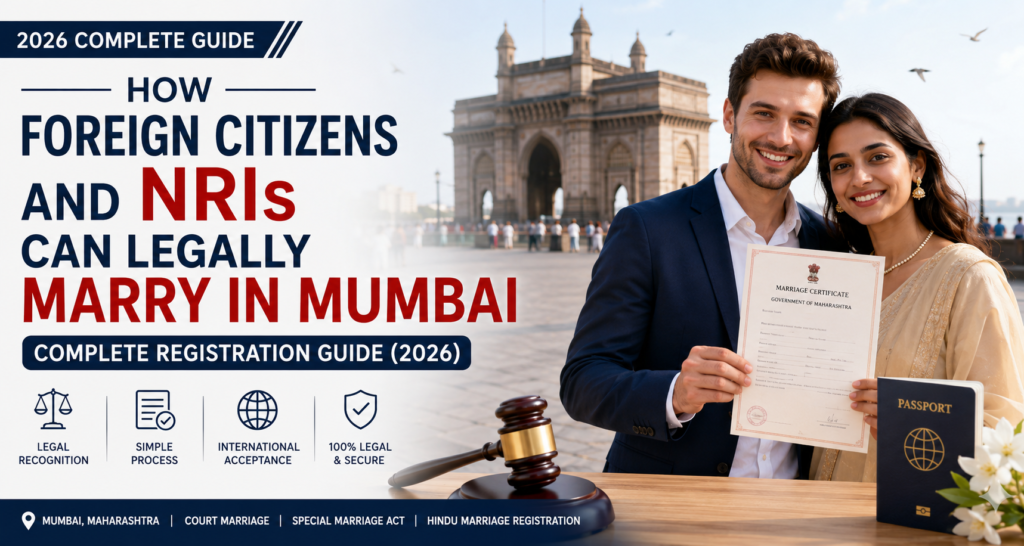
Introduction
International marriages have become increasingly common as people travel, work, and settle across different countries. Many couples consisting of Indian citizens, Non-Resident Indians (NRIs), Overseas Citizens of India (OCI), and foreign nationals choose Mumbai as their preferred location for marriage registration due to its well-established legal infrastructure and administrative convenience.
Understanding how foreign citizens and NRIs can legally marry in Mumbai is essential before beginning the registration process. Marriage registration not only provides legal recognition under Indian law but also serves as an important document for immigration applications, spouse visas, family sponsorship programs, overseas residency applications, banking formalities, and inheritance rights.
For couples planning a legally recognized marriage, seeking professional guidance regarding Court Marriage in Mumbai can help ensure compliance with legal requirements while minimizing procedural delays.
Indian marriage certificates are widely accepted by government authorities, embassies, consulates, immigration departments, and foreign institutions when properly registered and authenticated where required.
Can Foreign Citizens and NRIs Legally Marry in Mumbai?
Quick Answer
Yes. Foreign citizens and NRIs can legally marry in Mumbai provided they satisfy the eligibility criteria prescribed under applicable Indian marriage laws and submit the required documentation.
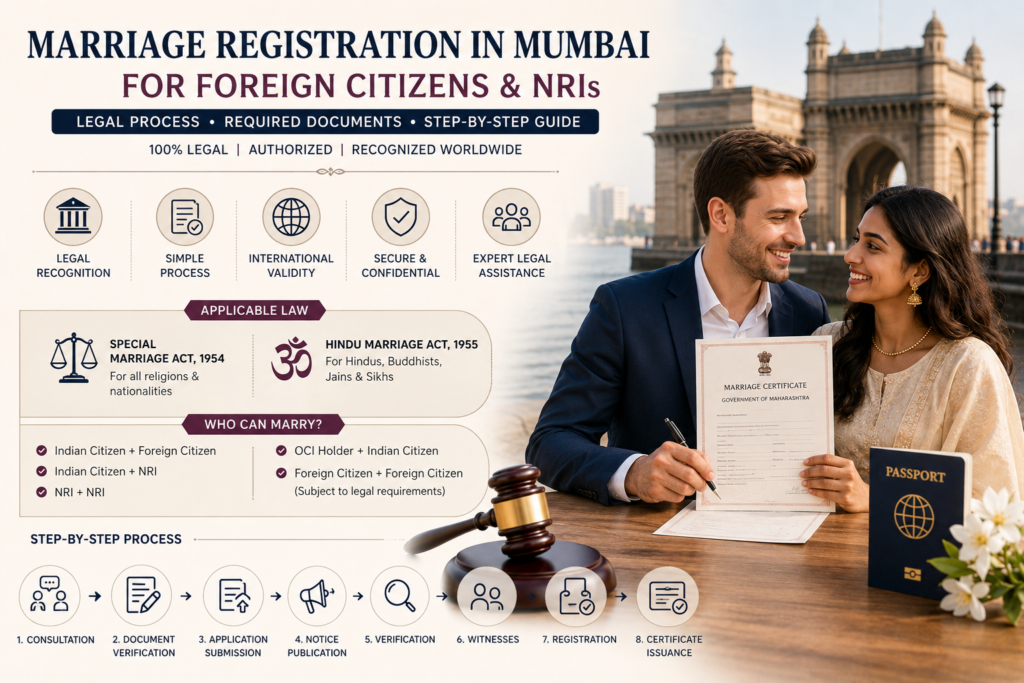
The following combinations are generally permitted:
- Indian Citizen and Foreign Citizen
- Indian Citizen and NRI
- NRI and NRI
- OCI Card Holder and Indian Citizen
- Foreign Citizen and Foreign Citizen (subject to legal requirements)
Many international couples seek guidance regarding NRI and Foreign National Marriage Registration to better understand documentation, legal procedures, and registration requirements applicable to their specific circumstances.
Legal Framework Governing International Marriages in India
The legal process applicable to an international marriage depends upon factors such as nationality, religion, marital status, and the nature of the marriage ceremony.
Marriage Under the Special Marriage Act
One of the most commonly used legal routes for international couples is Special Marriage Act Registration.
The Special Marriage Act, 1954 provides a secular legal framework that allows individuals of different religions, nationalities, and backgrounds to legally marry.
Who Should Consider the Special Marriage Act?
This option is particularly suitable for:
- Interfaith couples
- Foreign nationals marrying Indian citizens
- NRI couples
- Couples seeking a civil marriage
- Couples requiring international recognition
Benefits of Registration Under the Special Marriage Act
- Legally recognized throughout India
- Suitable for couples from different religions
- Widely accepted by immigration authorities
- Useful for spouse visa applications
- Provides strong legal protection
Legal Validity
A marriage certificate issued under the Special Marriage Act serves as valid proof of marriage and is generally accepted by government agencies, embassies, and international authorities.
Marriage Under Hindu Marriage Laws
Where both parties belong to Hindu, Sikh, Jain, or Buddhist communities and have completed customary marriage ceremonies, registration may be possible under Hindu marriage laws.
Couples may proceed through Hindu Ritual Court Marriage registration procedures after solemnizing their marriage according to recognized religious customs.
Eligibility Under Hindu Marriage Laws
Typically:
- Both parties must belong to eligible communities.
- A valid religious ceremony should have been performed.
- Legal age requirements must be satisfied.
- Parties must be legally capable of marriage.
Benefits
- Recognition of traditional ceremonies
- Legal marriage certificate issuance
- Acceptance for domestic and international purposes
Eligibility Criteria for Marriage Registration
Before initiating the registration process, both individuals must satisfy the legal eligibility requirements prescribed under Indian law.
Minimum Age Requirement
The prescribed age limits are:
| Applicant | Minimum Age |
| Male | 21 Years |
| Female | 18 Years |
Failure to satisfy age requirements can prevent marriage registration.
Mental Capacity
Both parties must possess the mental capacity to understand the nature of marriage and provide valid consent.
The marriage should be entered into voluntarily without coercion, fraud, or undue influence.
Marital Status
Applicants should be:
- Unmarried
- Legally divorced
- Widowed
Where a previous marriage existed, supporting documents such as divorce decrees or death certificates may be required.
Prohibited Relationships
The parties should not fall within prohibited degrees of relationship unless specifically permitted by applicable law, custom, or legal exception.
Authorities may verify compliance before registration is approved.
How Foreign Citizens and NRIs Can Legally Marry in Mumbai: Featured Answer
Foreign citizens and NRIs can legally marry in Mumbai by satisfying eligibility requirements, submitting valid identity and address documents, complying with applicable marriage laws such as the Special Marriage Act or Hindu Marriage Act, completing procedural formalities, and obtaining a legally recognized marriage certificate from the competent authority.
Documents Required for Foreigner and NRI Marriage Registration
Documentation is one of the most important aspects of international marriage registration. The exact documents required may vary depending on nationality, immigration status, previous marital history, and the applicable marriage law.
Before initiating the application process, couples should carefully review the complete list of Documents Required for Court Marriage to ensure all paperwork is available and properly authenticated.
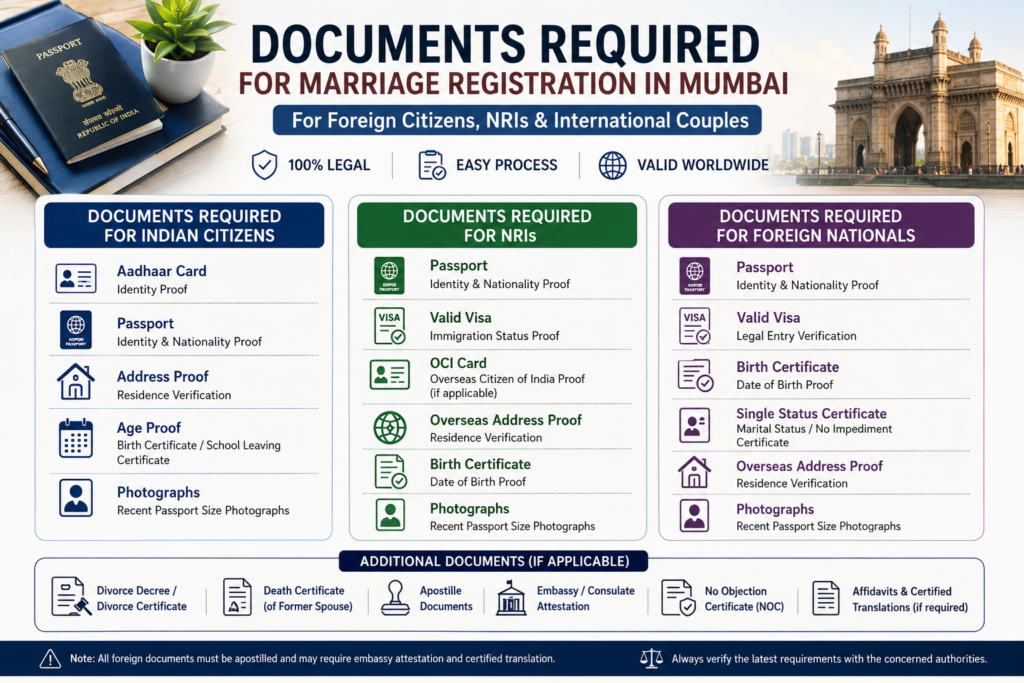
Documents Required for Indian Citizens
| Document | Purpose |
| Aadhaar Card | Identity Proof |
| Passport | Identity & Nationality Verification |
| Address Proof | Residence Verification |
| Birth Certificate | Age Verification |
| School Leaving Certificate | Age Proof |
| Passport Size Photographs | Application Requirements |
Documents Required for NRIs
| Document | Purpose |
| Passport | Identity & Nationality |
| Valid Visa | Immigration Status |
| OCI Card (if applicable) | Overseas Citizen Verification |
| Overseas Address Proof | Residence Verification |
| Birth Certificate | Date of Birth Verification |
| Passport Size Photographs | Application Requirements |
Documents Required for Foreign Nationals
| Document | Purpose |
| Passport | Identity & Nationality |
| Valid Visa | Legal Entry Verification |
| Birth Certificate | Age Verification |
| Single Status Certificate | Marital Status Verification |
| Overseas Address Proof | Residence Verification |
| Passport Size Photographs | Registration Requirements |
Additional Documents That May Be Required
Depending on individual circumstances, authorities may request:
- Divorce Decree Absolute
- Death Certificate of Former Spouse
- No Objection Certificate (NOC)
- Embassy Verification Documents
- Apostille Documentation
- Affidavits
- Certified Translations
- Immigration Documents
Proper document verification can significantly reduce registration delays and legal complications.
Step-by-Step Registration Process
Step 1: Initial Consultation
The first stage involves reviewing the eligibility of both parties and determining the appropriate legal framework for registration.
Authorities may assess:
- Nationality
- Religion
- Residency status
- Previous marital history
- Document availability
Step 2: Document Verification
All supporting documents are examined for:
- Authenticity
- Completeness
- Consistency
- Legal validity
Particular attention is given to foreign-issued documents and immigration records.
Step 3: Application Submission
After verification, the marriage registration application is submitted to the competent authority.
Information typically includes:
- Personal details
- Nationality details
- Address information
- Witness information
- Supporting documentation
Step 4: Notice Publication (Where Applicable)
For marriages under the Special Marriage Act, a statutory notice period may apply.
This notice allows legal objections, if any, to be raised within the prescribed period.
Step 5: Verification and Scrutiny
Authorities verify:
- Identity documents
- Immigration status
- Age requirements
- Marital status
- Supporting declarations
Additional clarification may be requested where necessary.
Step 6: Witness Requirements
Witnesses play an important role during registration.
Generally:
- Adult witnesses are required.
- Witnesses should possess valid identification documents.
- Witnesses may need to be physically present.
Step 7: Marriage Registration
Upon successful completion of legal formalities, the marriage is registered before the competent authority.
Both parties and witnesses may be required to sign official records.
Step 8: Issuance of Marriage Certificate
After registration, an official marriage certificate is issued.
This certificate serves as legal proof of marriage and can be used for:
- Visa applications
- Immigration procedures
- Family sponsorship
- Banking purposes
- Property matters
- Overseas documentation
Common Challenges Faced by International Couples
International marriages often involve additional legal and administrative requirements.
Apostille Requirements
Many countries require documents to be apostilled before they can be accepted in India.
Apostille certification verifies the authenticity of foreign public documents.
Embassy Authentication
Certain jurisdictions require authentication through embassies or consulates before documents can be used for registration purposes.
Name Mismatch Issues
One of the most common problems involves inconsistencies between:
- Passport records
- Birth certificates
- Visa documents
- Identity documents
Even minor spelling differences may cause delays.
Visa-Related Challenges
Authorities may verify:
- Validity of visa
- Immigration status
- Period of stay
- Entry documentation
Expired or incomplete visa documentation may affect registration timelines.
Translation Requirements
Foreign-language documents often require:
- Certified translations
- Notarization
- Authentication
Improper translations can result in rejection of documents.
Overseas Documentation Delays
Obtaining:
- Single Status Certificates
- Divorce Records
- Embassy Certifications
- Apostille Documents
may require significant processing time in the applicant’s home country.
Benefits of Registering Marriage in Mumbai
Marriage registration provides numerous legal and practical advantages.
Legal Recognition
A registered marriage certificate serves as official proof of marriage under Indian law.
Immigration Benefits
Many countries require marriage certificates for:
- Immigration applications
- Permanent residency applications
- Dependent visas
Spouse Visa Applications
Marriage registration often forms the foundation for obtaining spouse and dependent visas.
Family Sponsorship
Many immigration programs require proof of a legally recognized marriage relationship.
Property and Inheritance Rights
Marriage registration can strengthen legal rights relating to:
- Property ownership
- Succession
- Inheritance
- Financial claims
Banking and Insurance Benefits
Couples frequently require marriage certificates for:
- Joint bank accounts
- Insurance nominations
- Investment planning
- Financial transactions
International Acceptance
Properly issued marriage certificates are widely accepted internationally and can be further authenticated where necessary.
Why Professional Legal Assistance Matters
International marriage registration often involves multiple legal, procedural, and documentation requirements.
Professional guidance can assist couples with:
- Eligibility assessment
- Documentation review
- Compliance with Indian law
- Foreign document verification
- Embassy requirements
- Registration formalities
Many couples seeking assistance with Court Marriage in Mumbai benefit from professional support that helps simplify the registration process and reduce administrative complications.
Conclusion
Understanding how foreign citizens and NRIs can legally marry in Mumbai is essential for ensuring a smooth and legally valid registration process. Whether the marriage involves an Indian citizen, NRI, OCI card holder, or foreign national, compliance with legal requirements, eligibility conditions, and documentation standards is critical.
International couples should carefully evaluate the applicable marriage law, gather the necessary documents, complete verification procedures, and obtain a legally recognized marriage certificate that can be used for immigration, visa applications, family sponsorship, and other legal purposes.
Seeking professional assistance for Court Marriage in Mumbai can help simplify the process, reduce delays, and ensure that all legal formalities are completed correctly. With proper preparation and guidance, foreign citizens and NRIs can successfully complete their marriage registration in Mumbai and obtain a marriage certificate recognized both in India and internationally.
Frequently Asked Questions (FAQs)
1. Can a foreign citizen marry an Indian citizen in Mumbai?
Yes. A foreign citizen can legally marry an Indian citizen in Mumbai provided both parties satisfy the eligibility requirements prescribed under Indian law and submit the necessary documents.
2. Can NRIs legally marry in India?
Yes. NRIs can legally marry in India under applicable marriage laws, including the Special Marriage Act and other relevant personal laws depending on their circumstances.
3. Can two foreign nationals marry in Mumbai?
Yes. In certain circumstances, two foreign nationals may register their marriage in Mumbai, subject to compliance with Indian legal requirements and documentation rules.
4. Which law applies to foreign citizen marriages in India?
The applicable law depends on the religion, nationality, and circumstances of the couple. Many international couples choose registration under the Special Marriage Act because of its secular and internationally recognized framework.
5. Is physical presence required for marriage registration?
Yes. Generally, both parties are required to be physically present during important stages of the registration process.
6. Is a passport mandatory for foreign nationals?
Yes. A valid passport is one of the most important identity documents required for foreign nationals seeking marriage registration in India.
7. What is a Single Status Certificate?
A Single Status Certificate is a document issued by a competent authority confirming that an individual is unmarried and legally free to marry.
8. How long does marriage registration take?
The timeline depends on the applicable legal procedure, document readiness, verification requirements, and individual circumstances.
9. Are witnesses required?
Yes. Marriage registration typically requires witnesses who can verify the identity of the parties and the marriage process.
10. Is an Indian marriage certificate valid internationally?
Yes. Marriage certificates issued by competent Indian authorities are generally accepted internationally, although additional authentication such as apostille or embassy attestation may be required in some countries.
11. What documents are required for NRI marriage registration?
Commonly required documents include:
- Passport
- Visa
- Address proof
- Birth certificate
- Photographs
- Additional supporting documents where applicable
12. Can divorced individuals register a marriage in Mumbai?
Yes. Divorced individuals can legally marry again provided a valid divorce decree has been obtained and supporting documentation is submitted.
13. Can widowed individuals remarry in India?
Yes. Widowed individuals can legally remarry after providing the death certificate of the former spouse where required.
14. Do foreign documents require apostille certification?
In many cases, yes. Apostille certification helps verify the authenticity of foreign-issued documents for use in India.
15. Can documents in a foreign language be submitted directly?
Generally, certified translations may be required before submission to authorities.
16. Is an OCI Card mandatory for marriage registration?
No. However, OCI card holders may need to submit their OCI documentation where applicable.
17. Can marriage registration help with spouse visa applications?
Yes. A legally issued marriage certificate is often a key requirement for spouse visa and family sponsorship applications.