
Introduction
Mumbai is one of India’s most preferred destinations for marriage registration, especially for Non-Resident Indians (NRIs), Overseas Citizens of India (OCI card holders), foreign nationals, and couples belonging to different religions or communities. With its well-established legal infrastructure and access to experienced marriage registration professionals, Mumbai continues to attract couples seeking legally recognized marriages under Indian law.
For many overseas Indians, obtaining a legally valid marriage certificate is essential for visa applications, immigration processes, spouse sponsorship, foreign residency applications, inheritance matters, banking formalities, and international legal recognition. As a result, the demand for Court Marriage in Mumbai for NRI couples has increased significantly in recent years.
One of the most commonly used legal frameworks for NRI marriages in India is the Special Marriage Act, 1954. Unlike religious marriage laws, this Act provides a secular and legally recognized procedure for marriage registration irrespective of religion, caste, nationality, or community.
Whether you are an NRI planning to marry an Indian citizen, another NRI, an OCI card holder, or a foreign national, understanding the legal requirements under the Special Marriage Act is crucial before beginning the registration process.
This comprehensive guide explains eligibility criteria, legal conditions, required documents, and the registration process for NRI Marriage Registration Mumbai under the Special Marriage Act.
What Is the Special Marriage Act, 1954?
The Special Marriage Act, 1954 (SMA) is a central legislation enacted by the Government of India that provides a civil form of marriage for individuals regardless of their religion, caste, community, or nationality.
The Act was introduced to allow marriages outside traditional personal laws and religious ceremonies while ensuring full legal recognition of the marriage.
Purpose of the Special Marriage Act
The primary objectives of the Act are:
- To provide a secular form of marriage.
- To facilitate interfaith marriages.
- To enable inter-caste marriages.
- To allow marriage between Indian citizens and foreign nationals.
- To provide legal recognition and protection to couples marrying outside personal religious laws.
The Act is widely used for:
- Interfaith Court Marriage Mumbai
- Inter Caste Marriage Registration Mumbai
- NRI Marriage Registration Mumbai
- Foreign National Marriage Registration
- Civil Marriage Registration
Applicability of the Special Marriage Act
The Special Marriage Act can be used by:
NRI + Indian Citizen
An NRI residing abroad can legally marry an Indian citizen under the provisions of the Special Marriage Act.
NRI + NRI
Two NRIs may also marry under the Special Marriage Act if they satisfy the legal conditions and documentation requirements.
OCI Card Holder + Indian Citizen
OCI card holders frequently choose the Special Marriage Act for legal marriage registration in India.
Foreign National + Indian Citizen
Foreign nationals can legally marry Indian citizens under the Act subject to compliance with documentation and legal requirements.
Interfaith Couples
Individuals belonging to different religions can marry without conversion.
Inter-Caste Couples
Individuals belonging to different castes can legally marry without restrictions.
Why NRIs Prefer the Special Marriage Act
Many overseas Indians choose the Special Marriage Act because it offers:
Legal Recognition Worldwide
Marriage certificates issued under the Act are widely accepted for:
- Immigration
- Visa applications
- Spouse sponsorship
- Overseas residency applications
- International documentation
No Religious Conversion Required
Couples from different religions can marry without changing their faith.
Strong Legal Validity
The marriage is recognized under Indian law and serves as valid proof of marriage for domestic and international purposes.
Suitable for International Couples
The Act provides a structured legal mechanism for marriages involving NRIs, OCI card holders, and foreign nationals.
Transparent Legal Procedure
The process follows a clear statutory framework with defined legal requirements and documentation standards.
Can NRIs Register Their Marriage Under the Special Marriage Act in Mumbai?
Yes.
NRIs can legally register their marriage under the Special Marriage Act in Mumbai provided they fulfill the statutory conditions prescribed under the Act.
The law does not prohibit NRIs from marrying in India. However, they must satisfy eligibility conditions relating to age, marital status, mental capacity, and procedural requirements.
Eligibility Criteria for NRI Marriage Registration
Age Requirement
At the time of marriage:
- Groom must have completed 21 years of age.
- Bride must have completed 18 years of age.
Existing Marriage Status
Neither party should have a living spouse at the time of marriage.
A person already married cannot legally enter into another marriage unless the previous marriage has been legally dissolved.
Mental Capacity Requirement
Both parties must be capable of giving valid consent to the marriage.
Neither party should suffer from a condition that legally prevents them from understanding the nature and consequences of marriage.
Prohibited Relationship Restriction
The parties should not fall within prohibited degrees of relationship unless a valid custom permits such a marriage under applicable law.
Residency Requirement for NRIs
One of the most important requirements under the Special Marriage Act is the residency condition.
Before filing the Notice of Intended Marriage, at least one of the parties must have resided within the jurisdiction of the concerned Marriage Officer for a minimum period of 30 days immediately preceding the date of notice.
This requirement is particularly important for NRI couples planning a short visit to India.
Proper documentary evidence is generally required to establish residence within the relevant jurisdiction.
Is the 30-Day Notice Period Mandatory?
Under the statutory procedure of the Special Marriage Act, a notice of intended marriage is filed before the Marriage Officer.
The notice is published and remains subject to a statutory objection period of 30 days. If no legally sustainable objection is received, the marriage may proceed after the completion of the notice period.
Recent judicial discussions have continued to recognize the statutory nature of this notice period under the Act.
For this reason, couples planning Court Marriage Registration Mumbai for NRI should plan their travel schedule accordingly.
Who Can Apply Under the Special Marriage Act?
| Couple Type | Eligible Under SMA? | Remarks |
| NRI + Indian Citizen | Yes | Commonly registered under SMA |
| NRI + NRI | Yes | Subject to legal requirements |
| OCI Card Holder + Indian Citizen | Yes | Eligible with supporting documents |
| Foreign National + Indian Citizen | Yes | Additional documentation may apply |
| Interfaith Couples | Yes | No religious conversion required |
| Inter-Caste Couples | Yes | Fully recognized under Indian law |
Documents Required for NRI Marriage Registration in Mumbai
Proper documentation plays a critical role in successful marriage registration.
The exact document list may vary depending on the facts of each case, nationality of the parties, and directions of the concerned Marriage Officer.
Identity Documents
| Document | Purpose |
| Passport | Primary identity proof |
| OCI Card (if applicable) | OCI status verification |
| Visa Documents (if applicable) | Immigration status verification |
| Aadhaar Card | Indian identity proof |
Address Proof Documents
Any valid address proof may be required depending on the circumstances, including:
- Aadhaar Card
- Passport
- Driving Licence
- Utility Bills
- Rent Agreement
- Residence Certificate
- Overseas Address Documents (for NRI applicants)
Age Proof Documents
Acceptable documents generally include:
- Passport
- Birth Certificate
- School Leaving Certificate
- SSC Certificate
Marital Status Documents
The following may be required depending on individual circumstances:
Unmarried Applicants
- Single Status Affidavit
- Marital Status Declaration
Divorced Applicants
- Certified Divorce Decree
Widowed Applicants
- Death Certificate of Former Spouse
Single Status Certificate
In certain NRI and foreign national cases, a Single Status Certificate, No Impediment Certificate, or equivalent declaration may be required depending on nationality and document requirements.
The specific requirement can vary depending upon the applicant’s country of residence and the concerned authority processing the marriage application.
Passport Size Photographs
Recent passport-size photographs of both parties are generally required for registration records.
Witness Documents
The Special Marriage Act requires witnesses at the time of solemnization.
Witnesses are typically required to provide:
- Identity Proof
- Address Proof
- Passport Size Photographs
The exact witness requirements may vary based on local procedural practices and document verification standards.
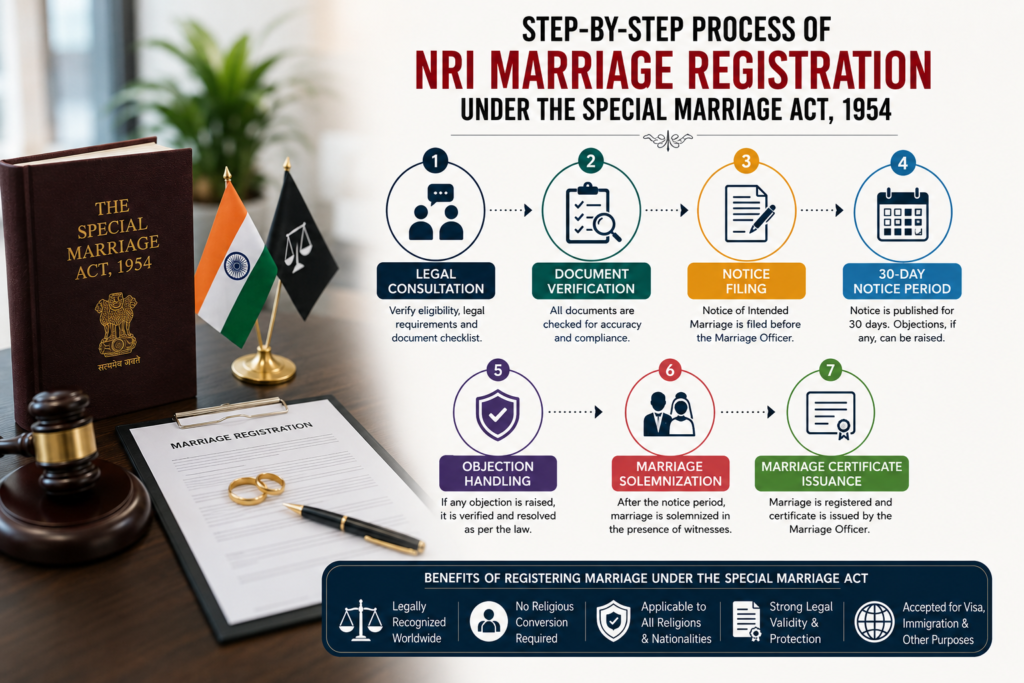
Step-by-Step Process of Court Marriage Registration Mumbai for NRI
Understanding the legal procedure is essential for every couple planning a Court Marriage in Mumbai for NRI purposes. While documentation requirements may vary depending on the nationality and circumstances of the parties, the overall process under the Special Marriage Act follows a structured legal framework.
Step 1: Initial Legal Consultation
The first step is to review the eligibility of both parties and verify whether the marriage can be registered under the Special Marriage Act.
During this stage, the following aspects are generally reviewed:
- Nationality of both parties
- Marital status
- Age eligibility
- Residency requirements
- Passport and visa documentation
- Availability of witnesses
- Foreign document requirements
A preliminary review helps identify potential issues before filing the marriage notice.
Step 2: Document Verification
Before initiating the registration process, all supporting documents should be verified carefully.
This typically includes:
- Passport verification
- Address proof verification
- Age proof verification
- Visa and immigration documents
- Marital status declarations
- Foreign-issued certificates
- Witness documents
Document discrepancies should be corrected before proceeding to avoid delays.
Step 3: Filing the Notice of Intended Marriage
Under the Special Marriage Act, the parties are required to submit a Notice of Intended Marriage before the Marriage Officer having jurisdiction.
The notice generally contains:
- Names of both parties
- Date of birth
- Occupation
- Address details
- Nationality details
- Marital status declaration
The Marriage Officer records the notice after examining the application and supporting documents.
Step 4: Completion of the Statutory Notice Period
After the notice is accepted, a statutory notice period follows.
During this period:
- The notice remains available for public inspection as prescribed by law.
- Any person may raise an objection if a legal ground exists under the Act.
- The Marriage Officer may examine objections, if any are received.
If no valid legal objection is sustained, the marriage may proceed after the completion of the notice period.
For this reason, NRI couples should plan their travel schedule well in advance.
Step 5: Resolution of Objections (If Any)
Most applications proceed without objections.
However, if an objection is raised, the Marriage Officer may conduct an inquiry to determine whether the objection has legal merit.
Examples may include:
- Existing marriage of a party
- Incorrect age declaration
- Prohibited relationship concerns
- False information in the application
If the objection is not legally sustainable, the process may continue.
Step 6: Solemnization of Marriage
After the legal requirements are satisfied, the marriage can be solemnized before the Marriage Officer.
The parties are required to:
- Appear personally
- Sign the prescribed declarations
- Confirm their consent
- Attend with witnesses
The marriage may be solemnized in accordance with the procedure prescribed under the Special Marriage Act.
Step 7: Marriage Certificate Issuance
After solemnization and completion of formalities, the Marriage Officer records the marriage and issues a Marriage Certificate.
The certificate serves as:
- Legal proof of marriage
- Evidence for immigration purposes
- Visa application support document
- Spouse sponsorship document
- International documentation proof
For many NRI couples, this certificate becomes one of the most important legal documents for future overseas applications.
NRI Marriage Registration Timeline in Mumbai
The actual timeline may vary depending on documentation, residency compliance, public holidays, administrative workload, and individual circumstances.
| Stage | Estimated Timeline |
| Initial Consultation | 1 Day |
| Document Collection | 1–7 Days |
| Residency Compliance (if applicable) | Minimum 30 Days |
| Notice Filing | 1 Day |
| Statutory Notice Period | 30 Days |
| Marriage Solemnization | After completion of notice period |
| Marriage Certificate Issuance | Usually on completion of registration formalities |
Sample Timeline for NRI Couples
| Activity | Approximate Duration |
| Arrival in India | Day 1 |
| Residency Requirement Completion | Day 30 |
| Notice Filing | Day 31 |
| Statutory Notice Period | Day 31–60 |
| Marriage Solemnization | After completion of statutory process |
| Marriage Certificate | As per Marriage Officer’s procedure |
Couples should avoid making travel plans based on assumptions and should always verify timelines in advance.
Is Same Day Marriage Registration Mumbai Possible for NRIs?
One of the most common questions asked by overseas Indians is whether same-day marriage registration is possible.
The answer depends on the legal framework under which the marriage is being processed.
Understanding the Legal Reality
Under the Special Marriage Act, the statutory notice procedure forms a fundamental part of the registration process.
As a result, a marriage under the Special Marriage Act generally cannot bypass the statutory requirements prescribed by law.
Therefore, couples seeking registration under this Act should not assume that same-day registration is available.
When Can Same-Day Marriage Registration Be Possible?
In certain circumstances, registration of a marriage that has already been solemnized under applicable personal laws may follow a different legal route.
Examples may include:
- Hindu marriage registration after a valid Hindu ceremony
- Registration of an already solemnized marriage under applicable laws
- Cases where legal requirements have already been fulfilled
However, eligibility depends entirely on the facts of the case and applicable law.
Common Misconceptions Among NRIs
Misconception 1: Court Marriage Can Always Be Completed in One Day
Reality:
The Special Marriage Act contains procedural requirements that must be complied with before registration.
Misconception 2: Foreign Citizenship Removes Notice Requirements
Reality:
Nationality does not automatically exempt parties from statutory requirements under the Act.
Misconception 3: All Marriage Registration Processes Are Identical
Reality:
Different laws govern different types of marriage registration.
The procedure under the Special Marriage Act differs from the registration of marriages already solemnized under personal laws.
Interfaith Court Marriage Mumbai for NRIs
Interfaith marriages are among the most common reasons couples choose the Special Marriage Act.
An interfaith marriage involves parties belonging to different religions.
Examples include:
- Hindu and Muslim
- Hindu and Christian
- Sikh and Christian
- Jain and Muslim
- Buddhist and Christian
The Special Marriage Act allows such marriages without requiring either party to convert religion.
Why Interfaith Couples Prefer the Special Marriage Act
No Religious Conversion
The parties may retain their respective faiths.
Legal Recognition
The marriage receives legal recognition under Indian law.
Uniform Procedure
The registration process remains the same regardless of religion.
International Acceptance
The marriage certificate can be used for immigration and overseas documentation purposes.
Documents Generally Required for Interfaith Couples
In addition to standard identity and address documents:
- Passport (where applicable)
- Visa documents (where applicable)
- Age proof
- Marital status declaration
- Witness documents
Additional documentation may be requested depending on the circumstances of the case.
Inter Caste Marriage Registration Mumbai
The Special Marriage Act also provides legal protection and recognition to inter-caste marriages.
India’s legal system fully recognizes marriages between individuals belonging to different castes.
Is Inter-Caste Marriage Legal in India?
Yes.
Inter-caste marriages are legally valid and protected under Indian law.
No person can be denied the right to marry solely because the parties belong to different castes.
Registration Process for Inter-Caste Couples
The process generally follows the same legal framework applicable under the Special Marriage Act.
The parties must satisfy:
- Age requirements
- Marital status requirements
- Residency requirements
- Documentation requirements
Benefits of Registering an Inter-Caste Marriage
- Legal recognition
- Official marriage certificate
- Protection of marital rights
- Simplified documentation for future legal purposes
- Immigration and visa support documentation
Concerns Frequently Raised by Couples
Many couples ask:
- Will caste difference affect registration?
- Is family approval mandatory?
- Can registration be denied due to caste?
Under Indian law, caste alone does not invalidate an otherwise lawful marriage.
The focus remains on statutory eligibility and legal compliance rather than social background.
Special Marriage Act vs Hindu Marriage Act for NRIs
Many NRI couples are often confused about whether they should proceed under the Special Marriage Act, 1954, or the Hindu Marriage Act, 1955. The correct choice depends on the religion of the parties, the nature of the marriage ceremony, and their legal objectives.
Understanding the differences can help couples avoid delays and choose the most suitable legal route for marriage registration.
Comparison Between Special Marriage Act and Hindu Marriage Act
| Factor | Special Marriage Act, 1954 | Hindu Marriage Act, 1955 |
| Applicability | Persons of any religion | Hindus, Buddhists, Jains, and Sikhs |
| Religious Ceremony Required | No | Yes |
| Interfaith Marriage | Allowed | Generally not applicable without conversion |
| Inter-Caste Marriage | Allowed | Allowed |
| Marriage Before Registration | Not required | Marriage ceremony generally precedes registration |
| Statutory Notice Period | Required | Not applicable in the same manner |
| Marriage Officer Involvement | Before marriage | Usually after marriage solemnization |
| NRI Suitability | Highly suitable | Suitable when both parties qualify under Hindu law |
| Legal Recognition | Fully recognized | Fully recognized |
| International Acceptance | Widely accepted | Widely accepted |
Which Law Is Better for NRI Couples?
The answer depends on the specific circumstances.
Special Marriage Act May Be Suitable When:
- The couple belongs to different religions.
- One party is a foreign national.
- One party is an NRI.
- The parties prefer a civil marriage.
- No religious ceremony is planned.
Hindu Marriage Act May Be Suitable When:
- Both parties are Hindus, Buddhists, Jains, or Sikhs.
- A valid religious marriage ceremony has already been performed.
- The couple seeks registration of an existing marriage.
Professional legal guidance can help determine the most appropriate route based on the facts of each case.
Common Challenges Faced by NRI Couples During Marriage Registration
Although the legal framework is straightforward, NRI couples frequently encounter documentation and procedural challenges.
Being aware of these issues can significantly reduce delays and complications.
Passport Information Mismatch
One of the most common issues involves inconsistencies between documents.
Examples include:
- Different spellings of names
- Missing middle names
- Variations in initials
- Different surnames across documents
Solution
All documents should be reviewed carefully before filing the application. Any discrepancies should be addressed through appropriate legal documentation wherever necessary.
Address Proof Issues
NRIs often maintain multiple addresses.
Common situations include:
- Overseas residential address
- Indian permanent address
- Temporary Mumbai residence
Address verification becomes important when establishing jurisdiction requirements.
Solution
Maintain clear documentary evidence supporting the address being used for the registration process.
Residency Requirement Confusion
Many NRIs assume they can arrive in India and immediately complete the marriage process.
However, the Special Marriage Act contains statutory residency and notice-related requirements.
Solution
Plan travel schedules well in advance and verify eligibility before making arrangements.
Visa and Immigration Documentation
Foreign nationals and overseas residents may face additional documentation requirements depending on their immigration status.
Examples include:
- Valid visa documentation
- Passport validity concerns
- Entry and exit records
Solution
Ensure that immigration documents remain valid throughout the registration process.
Single Status Documentation
Certain authorities may require declarations confirming that the applicant is unmarried and legally free to marry.
Obtaining such documentation from overseas jurisdictions can sometimes take time.
Solution
Start collecting overseas documents well before initiating the registration process.
Divorce Decree Recognition Issues
Applicants previously married outside India may need to provide supporting documentation relating to their divorce.
Additional scrutiny may arise depending on the nature of the foreign decree and applicable legal requirements.
Solution
Maintain certified copies of all relevant court orders and supporting documents.
Apostille and Attestation Requirements
NRI couples frequently require marriage certificates for use abroad.
Many countries require:
- Apostille certification
- Consular attestation
- Embassy legalization
Failure to comply with foreign documentation requirements can create difficulties later.
Solution
Understand the destination country’s requirements before submitting documents overseas.
Witness Availability
Witnesses play an important role in the marriage registration process.
NRI couples sometimes face challenges because family members or friends are not available on the required dates.
Solution
Ensure witness availability is planned well in advance of the scheduled appointment.
Limited Travel Window
Many overseas Indians visit India only for short periods.
A lack of planning can result in incomplete documentation and scheduling conflicts.
Solution
Prepare documentation before arriving in India and seek guidance regarding timelines.

Benefits of Hiring a Court Marriage Lawyer Mumbai
Marriage registration may appear straightforward, but legal guidance can help couples avoid procedural mistakes and documentation issues.
For NRI couples, professional assistance becomes particularly valuable due to the involvement of international documents and cross-border legal requirements.
Accurate Legal Guidance
Marriage laws involve specific eligibility criteria, documentation standards, and procedural requirements.
A qualified professional can help ensure compliance with the applicable legal framework.
Benefits include:
- Understanding legal requirements
- Clarifying eligibility
- Identifying potential issues early
- Avoiding procedural mistakes
Assistance with Document Verification
Many registration delays occur because documents are incomplete or inconsistent.
Professional review can help identify:
- Name mismatches
- Expired documents
- Missing declarations
- Incorrect address proofs
- Defective paperwork
Early detection can save considerable time and effort.
Support for NRI Documentation
NRI cases often involve:
- Passports
- Visa records
- OCI documentation
- Foreign address proofs
- Overseas declarations
- International certificates
Professional assistance helps ensure that such documents are prepared appropriately.
Better Process Management
The registration process involves multiple stages.
These may include:
- Eligibility review
- Document preparation
- Notice filing
- Appointment scheduling
- Witness coordination
- Marriage certificate issuance
Effective management can reduce unnecessary delays.
Assistance for Interfaith Couples
Interfaith Court Marriage Mumbai applications often involve additional concerns and questions.
Professional guidance can help explain:
- Legal rights
- Documentation requirements
- Registration procedure
- Applicable legal provisions
This often provides clarity and confidence to the parties involved.
Assistance for Inter-Caste Couples
Inter Caste Marriage Registration Mumbai applications may raise concerns regarding family objections, procedural issues, or legal misconceptions.
Legal guidance helps couples understand their rights under Indian law and proceed through the registration process correctly.
Help with Apostille and International Use
For many NRI couples, the marriage certificate is only the first step.
The certificate may later be used for:
- Immigration
- Family visas
- Spouse sponsorship
- Residency permits
- Overseas legal documentation
Professional guidance regarding apostille and attestation requirements can be valuable.
Reduced Risk of Delays
One of the biggest advantages of professional assistance is minimizing avoidable delays.
Common causes of delay include:
- Missing documents
- Incorrect declarations
- Witness issues
- Scheduling problems
- Documentation inconsistencies
Careful preparation significantly improves the overall experience.
Why Professional Assistance Matters for NRI Marriage Registration Mumbai
NRI marriages frequently involve multiple jurisdictions, international documentation, and strict legal compliance requirements.
A properly managed process can help couples:
- Save time
- Avoid legal complications
- Ensure documentation accuracy
- Obtain a legally valid marriage certificate
- Prepare documents for international use
For couples seeking Court Marriage in Mumbai for NRI, obtaining proper legal guidance can make the registration process significantly smoother and more efficient.
Frequently Asked Questions (FAQs) About NRI Marriage Registration Under the Special Marriage Act in Mumbai
1. Can an NRI marry an Indian citizen in Mumbai?
Yes. An NRI can legally marry an Indian citizen in Mumbai under the Special Marriage Act, 1954, provided both parties satisfy the legal requirements relating to age, marital status, mental capacity, and statutory procedures prescribed under the Act.
2. Can two NRIs register their marriage in Mumbai?
Yes. Two NRIs may register their marriage under the Special Marriage Act if they fulfill the eligibility conditions and comply with the applicable documentation and procedural requirements.
3. Is the Special Marriage Act applicable to foreign nationals?
Yes. Foreign nationals can marry Indian citizens under the Special Marriage Act subject to compliance with applicable legal and documentation requirements.
4. Is religious conversion required under the Special Marriage Act?
No. One of the major advantages of the Special Marriage Act is that parties belonging to different religions can marry without changing their religion.
5. What is the minimum age for marriage under the Special Marriage Act?
The groom must be at least 21 years old and the bride must be at least 18 years old at the time of marriage.
6. Is a passport mandatory for NRI marriage registration?
In most NRI cases, a valid passport serves as a primary identity and nationality document and is generally required.
7. Is a visa required for marriage registration in Mumbai?
Where applicable, valid visa documentation may be required to establish lawful immigration status.
8. Is a Single Status Certificate mandatory?
The requirement may vary depending on nationality, documentation circumstances, and the authority concerned. Some NRI and foreign national cases may require proof that the individual is legally free to marry.
9. Can a divorced NRI marry under the Special Marriage Act?
Yes. However, the applicant must provide legally valid documentation demonstrating that the previous marriage has been legally dissolved.
10. Can a widowed NRI apply for marriage registration?
Yes. The applicant may be required to provide the death certificate of the deceased spouse.
11. How many witnesses are required?
The Special Marriage Act generally requires three witnesses to be present at the time of solemnization and registration.
12. Can parents object to an adult marriage?
Marriage decisions made by legally eligible adults are governed by law. Family disagreement alone does not invalidate a legally valid marriage.
13. Can interfaith couples register their marriage under the Special Marriage Act?
Yes. The Act specifically provides a legal framework for marriages between persons belonging to different religions.
14. Can inter-caste couples register their marriage?
Yes. Inter-caste marriages are fully legal and recognized under Indian law.
15. How long does NRI Marriage Registration Mumbai take?
The overall timeline depends upon documentation, residency compliance, statutory notice requirements, and administrative processing.
16. Is online marriage registration available?
Certain application-related processes may be available online depending on the local authority. However, personal appearance requirements generally remain part of the legal process.
17. Can an NRI complete the entire process during a short visit to India?
This depends upon individual circumstances, documentation readiness, and compliance with statutory requirements. Advance planning is strongly recommended.
18. Is the marriage certificate valid outside India?
Marriage certificates issued under Indian law are generally accepted internationally, although apostille or attestation may be required depending on the destination country.
19. Can the marriage certificate be apostilled?
Yes. Marriage certificates can generally be apostilled for use in countries that are members of the Hague Apostille Convention.
20. What is apostille certification?
Apostille is a form of international document authentication that enables documents issued in one member country to be recognized in another member country.
21. Can OCI card holders marry under the Special Marriage Act?
Yes. OCI card holders may marry under the Special Marriage Act subject to compliance with applicable legal requirements.
22. Can foreign-issued documents be used?
Foreign-issued documents may be accepted subject to applicable legal requirements, authentication procedures, and document verification standards.
23. Is a marriage lawyer mandatory?
The law does not require couples to engage a lawyer. However, professional assistance may help reduce documentation errors and procedural delays.
24. Can a marriage certificate be used for spouse visa applications?
Yes. Marriage certificates frequently serve as supporting documents for spouse visas, family reunification applications, and immigration processes.
25. Can an NRI change their surname after marriage?
Surname changes involve separate legal and administrative procedures. Couples should verify specific requirements with the relevant authorities.
Conclusion
The Special Marriage Act, 1954 provides a legally recognized framework for marriage registration irrespective of religion, caste, nationality, or community.
For couples seeking Court Marriage in Mumbai for NRI, the Act offers a secure and transparent legal process that is widely accepted for immigration, spouse sponsorship, visa applications, overseas residency, and international documentation purposes.
Whether the marriage involves:
- An NRI and an Indian citizen
- Two NRIs
- An OCI card holder
- A foreign national
- An interfaith couple
- An inter-caste couple
the Special Marriage Act remains one of the most reliable legal mechanisms available in India.
Before proceeding, couples should ensure that they:
- Meet the eligibility requirements
- Prepare all required documents
- Understand the statutory process
- Plan timelines appropriately
- Seek professional guidance where necessary
Proper preparation can help make NRI Marriage Registration Mumbai smoother, faster, and legally compliant.