
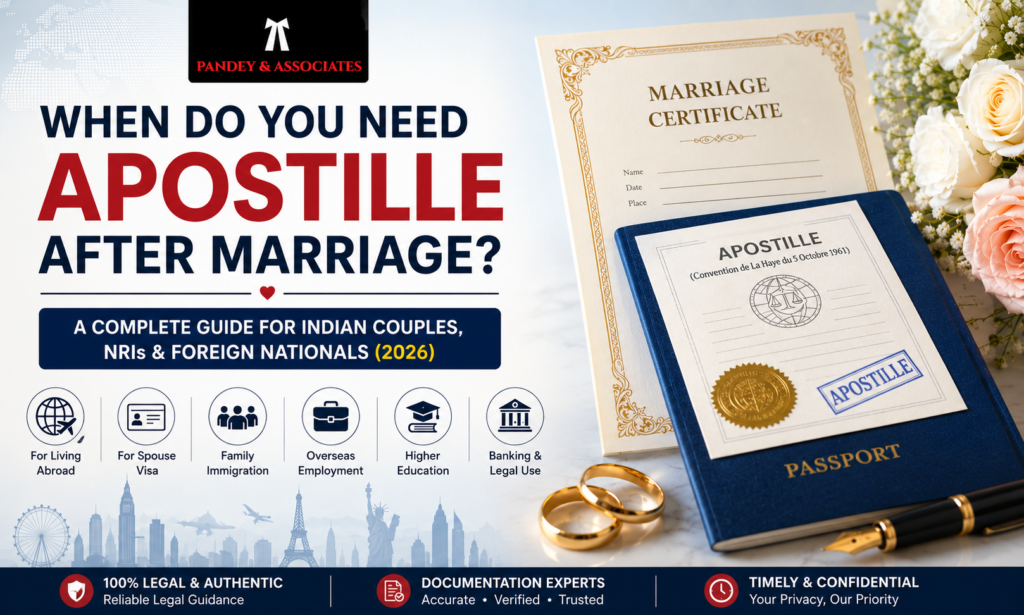
Introduction
Marriage is one of life’s biggest milestones, but for many couples, especially those planning to move abroad, the legal journey doesn’t end with the wedding ceremony. After marriage, several official documents may need international recognition before they are accepted in another country. One of the most important legal authentication processes for this purpose is Apostille.
Whether you’re relocating overseas, applying for a spouse visa, pursuing higher education, accepting an international job offer, or sponsoring your partner for immigration, your marriage certificate and other supporting documents may need an Apostille.
Many couples are unaware of this requirement until an embassy, employer, university, or immigration authority requests an apostilled marriage certificate. This often creates unnecessary delays, especially when travel deadlines are approaching.
At Pandey & Associates, we frequently assist Indian residents, NRIs, and foreign nationals who require guidance on marriage documentation and international legalization. Clients who complete Marriage Registration Mumbai or Court Marriage in Mumbai often approach us later when they need their marriage certificate authenticated for use abroad.
This comprehensive guide explains what Apostille is, when it becomes necessary after marriage, which documents require Apostille, and how Indian couples, NRIs, and foreign nationals can prepare their paperwork correctly.
Quick Answer
What Is Apostille?
An Apostille is an internationally recognized certificate issued on a public document that verifies its authenticity for use in countries that are members of the Hague Apostille Convention. It confirms that the signature, seal, or stamp on the document is genuine.
At a Glance
| Topic | Details |
| Purpose | International document authentication |
| Applicable For | Marriage certificates and other public documents |
| Issuing Authority in India | Ministry of External Affairs (MEA) through authorized channels |
| Accepted In | Hague Convention member countries |
| Common Users | Married couples, NRIs, foreign nationals, students, professionals |
Why Does Apostille Become Important After Marriage?
Marriage often opens doors to new opportunities, including overseas employment, higher education, permanent residency, or settling with a spouse in another country. While your marriage certificate is legally valid within India, many foreign governments require additional authentication before recognizing it.
This is where Apostille becomes essential.
For example, if an Indian citizen marries and later applies for a spouse visa in another country, immigration authorities may request an apostilled marriage certificate as proof of the marital relationship.
Similarly, couples applying for NRI Marriage Registration in Mumbai or completing legal documentation for international purposes should understand whether their destination country accepts Apostille or requires a different legalization process.
Obtaining Apostille in advance can help avoid last-minute delays during visa or immigration applications.
Common Situations Where Apostille Is Required
You may require Apostille after marriage if you are planning to:
- Apply for a spouse visa
- Sponsor your husband or wife overseas
- Apply for permanent residency
- Join your spouse abroad
- Submit marriage proof to a foreign employer
- Purchase property outside India
- Open joint bank accounts overseas
- Apply for dependent visas
- Register your marriage in another country
- Complete immigration documentation
Couples who recently completed Court Marriage in Mumbai for NRI frequently require Apostille because foreign authorities generally request authenticated Indian marriage certificates before processing immigration applications.
Key Takeaway
If your marriage certificate will be used outside India in a Hague Convention member country, there is a strong possibility that Apostille will be required.
What Is Apostille?
Apostille is a form of international document authentication introduced under the Hague Apostille Convention of 1961.
Before the Convention was established, documents often had to go through lengthy embassy legalization procedures. Apostille simplified this process by creating a standardized certificate accepted among participating countries.
When a marriage certificate receives an Apostille, it does not certify that the contents are true. Instead, it certifies that the issuing authority’s signature and seal are authentic.
This distinction is important because Apostille verifies the document’s official origin—not the personal information contained within it.
Definition
Apostille is an official authentication certificate issued for public documents so they can be legally recognized in another Hague Convention member country.
Key Takeaway
An Apostille confirms authenticity—not accuracy of the document’s contents.
Apostille vs Notarization
Many people assume that notarization and Apostille are the same. They are not.
| Notarization | Apostille |
| Performed by a Notary Public | Issued after official authentication through authorized government channels |
| Valid mainly within India | Recognized internationally in Hague Convention countries |
| Confirms signatures on documents | Confirms authenticity of government-issued public documents |
| Often the first step | Usually the final authentication for international use |
Understanding this difference helps couples avoid unnecessary confusion when preparing documents for overseas submission.
Why Married Couples Need Apostille
Not every married couple requires Apostille. However, if your future plans involve another country, Apostille may become an essential legal requirement.
Below are the most common situations.
1. Spouse Visa Applications
One of the most common reasons for obtaining Apostille is applying for a spouse or dependent visa.
Immigration authorities often require authenticated marriage certificates before recognizing the marital relationship.
This applies to couples relocating for:
- Employment
- Permanent residency
- Family reunification
- Long-term residence
2. Immigration
Countries carefully verify civil documents during immigration procedures.
An apostilled marriage certificate provides internationally recognized authentication, making verification more straightforward for participating countries.
3. Overseas Employment
Professionals accepting overseas employment sometimes need to submit marriage-related documents when applying for dependent visas or employment benefits for spouses.
Properly authenticated documentation can prevent unnecessary administrative delays.
4. Higher Education Abroad
Students relocating overseas with their spouse may be asked to provide an apostilled marriage certificate while applying for family visas or dependent status.
5. Banking and Financial Purposes
Some international financial institutions request authenticated marriage documents before allowing spouses to:
- Open joint accounts
- Add nominees
- Update beneficiary information
Although requirements vary by country and institution, Apostille is commonly accepted where applicable.
6. Property and Inheritance Matters
When purchasing property jointly or claiming inheritance abroad, local authorities may request authenticated marriage documents as proof of the legal relationship.
7. Child Immigration and Family Sponsorship
Parents sponsoring children or applying for family immigration may need Apostille for marriage-related documents to establish legal family relationships.
Why Apostille Matters for NRIs
For Non-Resident Indians, international documentation is often part of everyday life.
Whether you’re relocating permanently or temporarily, proper authentication helps ensure that Indian documents are accepted overseas.
Couples completing Court Marriage Registration in Mumbai for NRI and Foreign Nationals frequently require Apostille because foreign immigration authorities often request authenticated marriage certificates before processing applications.
Understanding these requirements before beginning immigration procedures can save valuable time and reduce unnecessary stress.
Expert Insight from Pandey & Associates
Every country has its own documentation rules. While Apostille is accepted in Hague Convention member countries, some nations may require embassy legalization instead.
Similarly, documentation requirements may vary depending on the Ministry of External Affairs (MEA), the destination country’s embassy, local immigration authorities, and the specific purpose for which the document will be used.
For this reason, couples should always verify the latest legal requirements before submitting documents internationally.
At Pandey & Associates, we encourage couples to prepare their marriage-related documents well in advance, especially if they anticipate international travel, employment, or immigration in the future.
Which Marriage Documents Can Be Apostilled?
One of the most common questions couples ask after completing their marriage registration is, “Which documents actually need an Apostille?” The answer depends on why you’re travelling abroad and what the foreign authority requires.
In most cases, an Apostille is applied to public documents issued by government authorities or documents that have completed the necessary verification process in India. If you’re applying for a spouse visa, permanent residency, overseas employment, or higher education, the destination country may request one or more apostilled documents.
Couples who have completed Marriage Registration Mumbai should ensure that they obtain an official marriage certificate before beginning the Apostille process. If your marriage has not yet been legally registered, completing the registration is generally the first step before applying for authentication.
Quick Answer
Which Documents Usually Require Apostille After Marriage?
The documents commonly submitted for Apostille include:
- Marriage Certificate
- Birth Certificate
- Passport Copies (where required)
- Educational Certificates
- Police Clearance Certificate (PCC)
- Single Status Letter
- Divorce Decree (if applicable)
- Affidavits required by foreign authorities
The exact list depends on the destination country and the purpose of submission.
Documents That Can Be Apostilled
Below is a detailed overview of the most commonly apostilled documents after marriage.
| Document | Common Purpose | Apostille Required?* |
| Marriage Certificate | Spouse visa, immigration, PR | Yes, if requested |
| Birth Certificate | Immigration, dependent visa | Yes |
| Passport Copy | Identity verification | Sometimes |
| Educational Certificates | Employment, higher education | Yes |
| Police Clearance Certificate | Immigration and work visa | Yes |
| Single Status Letter | Overseas marriage/legal proof | Yes |
| Divorce Decree | Remarriage abroad | Yes |
| Affidavits | Embassy-specific requirements | Depends on country |
*Requirements vary depending on the destination country and the authority requesting the document.
Marriage Certificate: The Most Commonly Apostilled Document
For married couples, the marriage certificate is usually the most important document requiring Apostille.
Foreign governments often request an authenticated marriage certificate to verify the legal relationship between spouses for:
- Spouse Visa
- Dependent Visa
- Permanent Residency
- Family Sponsorship
- Immigration
- Overseas Employment
- Banking Formalities
- Property Ownership
If your marriage was recently registered through Court Marriage in Mumbai, your official marriage certificate may later need Apostille if it is intended for use in another country.
Birth Certificate
Birth certificates are commonly required when couples apply for family immigration, dependent visas, or overseas residency.
Some countries also request birth certificates for children accompanying their parents during immigration procedures.
Before applying for Apostille, ensure that the certificate has been issued by the appropriate government authority and that all personal details are accurate.
Educational Certificates
Many married couples relocate abroad because one spouse receives an employment opportunity or admission to an international university.
Educational certificates such as:
- Degree Certificates
- Diploma Certificates
- Mark Sheets
- Professional Qualifications
may require Apostille before they are accepted by overseas employers or educational institutions.
Police Clearance Certificate (PCC)
A Police Clearance Certificate (PCC) is frequently requested during immigration and long-term visa applications.
Several countries require both spouses to submit a PCC as part of their immigration process.
An Apostille helps verify the authenticity of the document for use in Hague Convention member countries.
Single Status Letter
A Single Status Letter is generally required before marriage when a foreign authority needs confirmation that an individual was legally unmarried at the time of marriage.
Although this document is obtained before the wedding in many cases, some embassies may request it later during immigration or legal verification.
Couples planning international relocation should confirm whether this document is required for their destination country.
Divorce Decree
If either spouse was previously married, a certified copy of the divorce decree may require Apostille before it is accepted abroad.
This helps foreign authorities verify that the previous marriage was legally dissolved.
Affidavits
Certain embassies request sworn affidavits relating to marriage, identity, residence, or relationship status.
Depending on the destination country, these affidavits may also require Apostille after completing the prescribed authentication process.
Step-by-Step Apostille Process in India
Although the exact process varies depending on the type of document, the Apostille procedure generally follows a structured sequence.
Step 1: Obtain the Original Document
Ensure that you possess the original government-issued document.
For marriage-related applications, this usually means obtaining an officially issued marriage certificate after completing Marriage Registration Mumbai.
Step 2: Verify Document Accuracy
Before submitting documents, carefully review:
- Name spelling
- Date of Birth
- Marriage Date
- Passport Numbers
- Address Details
Any discrepancy can result in delays or rejection.
Step 3: Complete Required State Authentication (If Applicable)
Some documents require authentication from the relevant State Government department before they are eligible for Apostille.
The applicable procedure depends on the document type and issuing authority.
Step 4: Apostille by the Ministry of External Affairs (MEA)
After completing the required verification, eligible documents are authenticated through the Ministry of External Affairs (MEA) using the prescribed Apostille process.
The Apostille certificate confirms the authenticity of the issuing authority’s signature and seal.
Step 5: Submit the Apostilled Document Overseas
Once Apostille is completed, the document can generally be submitted to immigration authorities, employers, universities, embassies, or government departments in Hague Convention member countries.
Always verify whether additional embassy-specific requirements apply.
Apostille for NRIs
For NRIs, document authentication is often an essential step when relocating family members or completing immigration formalities.
Applicants seeking NRI Marriage Registration in Mumbai frequently require Apostille after receiving their marriage certificate because foreign authorities generally request authenticated civil documents.
Couples planning Court Marriage in Mumbai for NRI should prepare their passports, visas, overseas address proof, and marriage certificate before beginning the Apostille process.
Early preparation helps prevent delays during visa applications and international documentation.
Apostille for Foreign Nationals Married in India
Foreign nationals who marry in India may also require Apostille depending on the legal requirements of their home country.
Applicants completing Court Marriage Registration in Mumbai for NRI and Foreign Nationals should carefully verify:
- Passport validity
- Visa status
- Marriage Certificate
- Birth Certificate
- Embassy-specific requirements
- Translation requirements (if applicable)
Some countries may require additional legalization procedures instead of Apostille if they are not members of the Hague Apostille Convention.
Key Takeaways
- Obtain an official marriage certificate before applying for Apostille.
- Verify that all personal details are accurate.
- Documentation requirements vary depending on the destination country, embassy, and purpose of travel.
- NRIs and foreign nationals should prepare international documents well in advance.
- Apostille authenticates the document’s origin but does not certify the truth of its contents.
Common Mistakes That Delay Apostille After Marriage
Applying for an Apostille may seem straightforward, but even minor documentation errors can result in delays, repeated verification, or rejection of your application. Many couples only realize these issues when they are working against strict visa or immigration deadlines.
Below are some of the most common mistakes and practical ways to avoid them.
1. Applying Without a Registered Marriage Certificate
One of the biggest mistakes is assuming that wedding photographs or a religious marriage certificate alone are sufficient for international use.
In most cases, foreign authorities require an officially issued marriage certificate before Apostille can be completed.
If your marriage has not yet been legally registered, complete Marriage Registration Mumbai before initiating the Apostille process.
Key Takeaway
A registered marriage certificate is generally the foundation of the Apostille process.
2. Incorrect Personal Information
Always verify that the following information matches across all documents:
- Full Name
- Father’s Name
- Date of Birth
- Passport Number
- Address
- Marriage Date
Differences between Aadhaar, Passport, Marriage Certificate, or Birth Certificate can delay authentication.
3. Using Damaged or Laminated Documents
Many authorities do not accept damaged, altered, or heavily laminated certificates.
Avoid:
- Torn certificates
- Illegible documents
- Plastic lamination covering official seals
- Documents with handwritten corrections
Always preserve original certificates in good condition.
4. Expired Passport
Applicants planning overseas immigration frequently overlook passport validity.
If either spouse’s passport has expired, renew it before proceeding with Apostille and visa documentation.
This is particularly important for couples applying for Court Marriage in Mumbai for NRI or NRI Marriage Registration in Mumbai.
5. Waiting Until the Last Minute
Many couples begin preparing documents only after receiving:
- Job Offer
- University Admission
- Immigration Approval
- Visa Appointment
Since document verification and authentication require time, last-minute preparation can create unnecessary stress.
Start collecting documents well before international travel.
6. Not Checking Destination Country Requirements
Every country has different documentation rules.
While Hague Convention countries generally accept Apostille, non-member countries may require embassy legalization instead.
Always confirm requirements directly with:
- Embassy
- Immigration Authority
- Employer
- University
- Government Department
Expert Checklist Before Applying for Apostille
Use the following checklist before submitting your documents.
Personal Documents
✔ Marriage Certificate
✔ Passport
✔ Birth Certificate
✔ Aadhaar Card
✔ PAN Card
✔ Passport-size Photographs
Supporting Documents
✔ Address Proof
✔ Police Clearance Certificate
✔ Educational Certificates
✔ Single Status Letter (if applicable)
✔ Divorce Decree (if applicable)
✔ Affidavits (if required)
Verification Checklist
✔ Names Match
✔ Dates Match
✔ Passport Valid
✔ Original Documents Available
✔ No Damage
✔ Correct Spellings
✔ Country Requirements Verified
Decision Guide: Do You Need Apostille?
Use this quick reference to determine whether Apostille may be required.
Question 1
Are you submitting your marriage certificate outside India?
Yes → Continue
No → Apostille may not be required.
↓
Question 2
Is the destination country a member of the Hague Apostille Convention?
Yes → Apostille is generally required.
No → Embassy legalization may be required instead.
↓
Question 3
Are you applying for:
- Spouse Visa
- Family Visa
- Immigration
- Overseas Employment
- Permanent Residency
If Yes, verify Apostille requirements with the receiving authority before submitting documents.
Quick Answer Boxes
What is Apostille?
An Apostille is an internationally recognized authentication certificate issued for public documents so they can be accepted in Hague Convention member countries. It verifies the authenticity of the issuing authority’s signature and seal.
Is Apostille Mandatory After Marriage?
Not always. Apostille is generally required only when your marriage certificate or other legal documents are intended for official use outside India in a Hague Convention country.
Can My Marriage Certificate Be Apostilled?
Yes. A legally issued marriage certificate can usually be apostilled after completing the required verification process, subject to applicable regulations.
Can NRIs Apply for Apostille?
Yes. NRIs can obtain Apostille for eligible Indian documents after completing the prescribed authentication process.
Is Apostille Needed for a Spouse Visa?
Many countries require an apostilled marriage certificate while processing spouse or dependent visa applications. Requirements vary depending on the destination country’s immigration laws.
How Long Does Apostille Take?
Processing time varies depending on document type, verification requirements, workload, and the applicable government procedures.
Can Someone Else Apply on My Behalf?
In many situations, an authorized representative or professional legal consultant may assist with document submission, subject to applicable rules.
Does Apostille Expire?
The Apostille certificate itself generally does not carry an expiry date. However, the receiving authority may impose validity requirements for the underlying document.
Frequently Asked Questions
1. Can I get Apostille before registering my marriage?
Generally, no. Since the marriage certificate is the primary document used for international recognition, you must first complete the legal marriage registration process and obtain the official certificate before applying for Apostille.
2. Is Apostille accepted in every country?
No. Apostille is accepted only in countries that are members of the Hague Apostille Convention. Countries that are not members may require embassy or consular legalization instead.
3. Can foreign nationals married in India apply for Apostille?
Yes. Foreign nationals who marry in India can obtain Apostille for eligible Indian documents, subject to the applicable legal procedures and the requirements of their home country.
4. What happens if my marriage certificate contains errors?
Errors in names, dates, or other personal details should generally be corrected by the issuing authority before applying for Apostille. Incorrect information can delay international document acceptance.
5. Do I need Apostille for every visa application?
Not necessarily. Requirements differ based on the visa category and the destination country’s immigration policies. Always verify the latest requirements with the relevant authority.
Conclusion
An Apostille plays a crucial role in ensuring that your Indian marriage documents are recognized internationally. Whether you’re relocating overseas, applying for a spouse visa, pursuing higher education, or completing immigration formalities, understanding the Apostille process can help you avoid unnecessary delays and documentation issues.
Before starting the process, ensure that your marriage is legally registered, your documents are complete, and your personal information is accurate. Since legal requirements vary depending on the destination country, the Ministry of External Affairs (MEA), embassy guidelines, and applicable regulations, always verify the latest procedures before submitting your application.
If you need guidance on Marriage Registration Mumbai, Court Marriage in Mumbai, Court Marriage in Mumbai for NRI, Court Marriage Registration in Mumbai for NRI and Foreign Nationals, Apostille Service in Mumbai, or related legal documentation, Pandey & Associates provides professional assistance tailored to Indian residents, NRIs, and foreign nationals. Our team helps clients understand documentation requirements, prepare accurate paperwork, and navigate marriage-related legal procedures with clarity and confidence.