
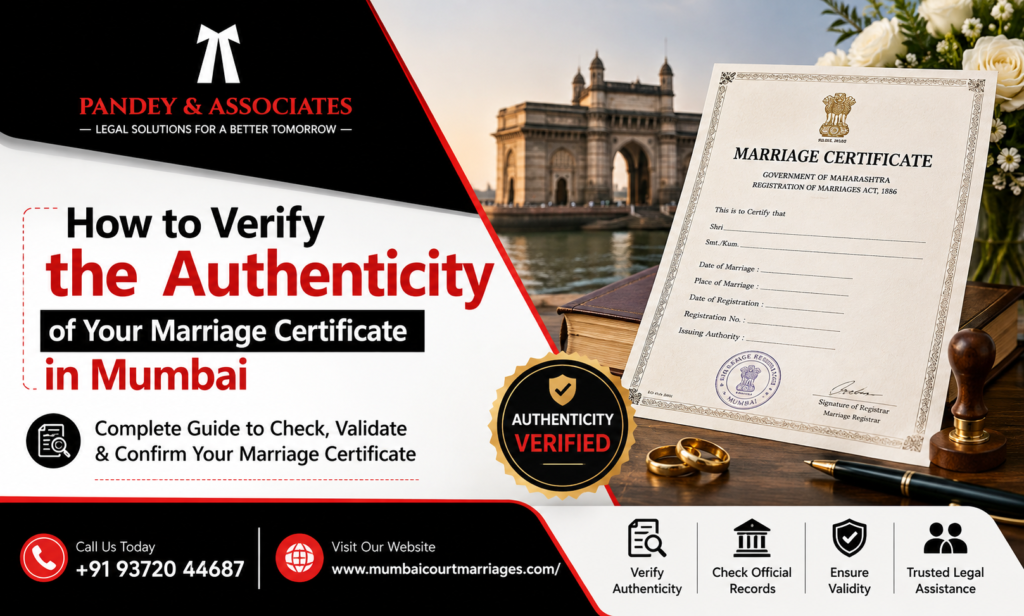
A marriage certificate is an important legal document that records a marriage registered with the competent authority. It may be required for immigration, spouse visas, passports, insurance, banking, property matters, legal proceedings, and other official purposes. However, simply possessing a certificate that looks official does not always answer an important question: does the certificate correspond to a genuine marriage registration record?
Marriage Certificate Verification in Mumbai generally means checking the information on the certificate against records maintained by the relevant marriage registration authority, where a verification facility is available. Important details may include the spouses’ names, registration number, dates, certificate details, and issuing authority. For formal confirmation, the relevant authority should be consulted.
This distinction becomes especially important when a certificate is being prepared for overseas use. Someone who completed Marriage Registration in Mumbai may later need to submit the certificate to an immigration authority, foreign government department, embassy, or other institution. Similarly, a person who completed Court Marriage in Mumbai may need to confirm that the certificate details match their passport and other identity documents before starting an authentication process.
What Does Marriage Certificate Verification Mean?
Marriage certificate verification means checking whether the information shown on a marriage certificate corresponds with the underlying registration record maintained by the competent authority. It is more than simply looking at the paper, seal, signature, formatting, or printed registration number. Formal verification may require confirmation from the authority that maintains the relevant marriage record.
A marriage certificate generally contains information identifying the marriage and the people involved. Depending on the certificate and issuing authority, this may include:
- Full names of both spouses
- Date of marriage
- Date of registration
- Registration number
- Certificate number, where applicable
- Place of registration
- Details of the marriage registration authority
- Signature or authentication
- Seal or other official features
- Digital authentication or QR-based verification, where officially provided
The exact format can vary. Older certificates may look very different from newer electronically generated certificates.
This is why Marriage Certificate Verification should not be based on appearance alone.
A document can appear professionally printed and still require official record verification. Conversely, an older certificate may have a format that looks unfamiliar today without necessarily being invalid.
Document inspection vs record verification
There are two different levels of checking:
Document inspection:
You examine the certificate for obvious inconsistencies, spelling errors, unusual alterations, missing information, or other concerns.
Official verification:
The relevant authority confirms whether the marriage registration and certificate information correspond with its records.
For situations involving immigration, litigation, foreign documentation, or suspected fraud, the second type of confirmation may be much more significant.
Key takeaway: A genuine-looking certificate is not the same thing as formally verified registration.
Why Should You Verify a Marriage Certificate?
Marriage certificate verification can help confirm that the document corresponds with an official marriage registration record before it is submitted for an important legal, financial, immigration, or administrative purpose. Verification can be particularly useful where another authority needs reliable evidence of the marriage.
There are many situations in which people may need to verify a certificate.
1. Immigration and spouse visas
A foreign immigration authority may request evidence of a legally registered marriage. Before submitting an Indian marriage certificate, the applicant may need to make sure that:
- Names are accurate
- Dates are consistent
- Registration details are correct
- The certificate was issued by the appropriate authority
- Any required authentication has been completed
Verification itself does not guarantee visa approval. Immigration authorities consider many other factors.
2. Passport and identity documentation
A discrepancy between a marriage certificate and passport can create administrative complications.
For example, if one document contains “Riya Mehta” while another contains “Riya Sharma” after a surname change, the applicant may need to provide additional documentation explaining the difference.
3. Overseas documentation
An Indian Marriage Certificate for Overseas Use may need additional authentication depending on the receiving country and purpose.
Verification, apostille, attestation, and legalisation are separate concepts.
4. Financial and insurance matters
Marriage certificates may be used for:
- Insurance claims
- Nomination changes
- Bank records
- Property matters
- Financial documentation
- Family-related legal matters
5. Legal proceedings
Where a marriage certificate is presented as evidence in a legal matter, questions about authenticity can become particularly important.
6. NRI documentation
An NRI Marriage Certificate may later be submitted to a foreign authority. Verifying the Indian registration details before beginning an overseas authentication process can help identify discrepancies early.
Key takeaway: Verification is especially useful when the certificate will be relied upon by another government authority, court, financial institution, or foreign organisation.
How to Check the Details on a Marriage Certificate
The first step in checking a marriage certificate is to compare all important details on the certificate with the spouses’ identity and supporting documents. A careful document review can reveal spelling differences, date discrepancies, registration inconsistencies, or other issues that should be addressed before formal verification.
Use the following checklist.
1. Check both spouses’ full names
Compare the names with:
- Passport
- Aadhaar
- PAN
- Other government-issued identity documents
Pay attention to initials, middle names, surname changes, and spelling.
2. Check the date of marriage
The date of marriage should be reviewed against the information provided in the marriage records and supporting documents.
3. Check the date of registration
The date of registration may be different from the date on which the marriage ceremony took place.
Do not automatically assume that the two dates should be identical.
4. Check the registration number
Look for the relevant marriage registration number or reference number shown on the certificate.
However, the presence of a number does not independently establish authenticity.
5. Check the certificate number
Some certificates may contain a separate certificate number. Whether such a number exists and how it is used depends on the issuing system.
6. Identify the issuing authority
Review the authority shown on the document.
The issuing authority matters because it determines where formal verification may need to be obtained.
7. Examine official authentication features
Depending on the certificate, this may include:
- Official seal
- Signature
- Digital signature
- Security features
- QR code
- Other verification features
Not every certificate will contain every feature.
8. Look for unexplained alterations
Pay attention to:
- Overwriting
- Erasures
- Different fonts
- Scratched-out information
- Unexplained corrections
- Inconsistent printing
These signs do not automatically prove fraud, but they may justify further verification.
How to Verify a Marriage Registration Number
A marriage registration number should be checked against the records or verification mechanism of the authority that issued or maintains the registration record. A printed number on a certificate is useful for identifying the record, but it should not be treated as conclusive proof of authenticity without appropriate confirmation.
Depending on the issuing authority and age of the record, verification may involve:
- An official online verification facility
- A government record search
- A certificate/reference number
- Manual confirmation
- A request to the relevant registration authority
If an official online facility is available, use the government or issuing authority’s official website rather than an unknown third-party verification website.
Why the number alone is not enough
Imagine a certificate contains registration number “MR-12345.”
The number may look legitimate, but the important question is whether the relevant authority’s records correspond with:
- The number
- Names
- Registration date
- Marriage date
- Other registration details
This is why Marriage Registration Verification should be considered a record-based process rather than simply a number-checking exercise.
Key takeaway: A registration number helps identify a record; it does not, by itself, prove that the certificate is genuine.
Can a Marriage Certificate Be Verified Online in Mumbai?
Some marriage certificates or marriage records may have online verification facilities, depending on the issuing authority, certificate type, age of the record, and whether the underlying records have been digitized. Online verification should only be performed through an official government or registration-authority facility where such a facility is available.
This is an important point because people often assume that every certificate issued in Mumbai must be searchable online.
That is not necessarily the case.
Why online availability can differ
A newer electronically generated certificate may have digital verification features that were not used for older physical records.
Older records may involve:
- Physical registers
- Archived records
- Manual searches
- Digitized records with limited search functionality
- Certified-copy procedures
Therefore, failure to find an old record through a particular online search does not automatically mean that the marriage certificate is invalid.
QR codes and digital verification
Some modern documents may include QR codes or other digital verification features.
However:
The presence or absence of a QR code alone should not be treated as conclusive proof of authenticity.
The official verification mechanism, if available, is more important than the visual feature itself.
Who Can Verify a Marriage Certificate?
Formal verification is generally associated with the marriage registration authority, registrar, or other competent government authority responsible for the relevant registration record. A private person can inspect the document, but formal confirmation may require communication with the authority that maintains the underlying record.
Depending on the circumstances, parties that may become relevant include:
- Marriage registrar
- Marriage registration authority
- Issuing government department
- Authorized government official
- Foreign authority
- Immigration authority
- Court
- Professional documentation service provider
The appropriate authority depends on how and where the marriage was registered.
A foreign embassy or immigration department may also have its own requirements for accepting the document, but that does not necessarily make the embassy the authority that originally verifies the Indian marriage registration.
What If the Details on the Certificate Do Not Match Your Other Documents?
A mismatch should be investigated before the marriage certificate is used for important government, financial, immigration, apostille, or attestation purposes. The correct solution depends on the nature of the discrepancy and whether the error exists in the certificate, the underlying registration record, or another identity document.
Common discrepancies include:
- Different surname
- Spelling variation
- Missing middle name
- Different date
- Incorrect address
- Different date of birth
- Incorrect registration details
- Variation in parents’ names
Why discrepancies matter
Suppose a person’s passport says:
Anita Shah
but the marriage certificate says:
Anita Saha
The difference may be only one letter, but a foreign authority could still question whether the documents refer to the same person.
This can become particularly important when applying for:
- Spouse visa
- Residence permit
- Immigration
- Passport services
- Marriage Certificate Apostille
- Marriage Certificate Attestation
The discrepancy should be addressed through the appropriate authority rather than ignored.
What If Your Marriage Certificate Has a Spelling Mistake?
Do not manually change or alter a marriage certificate to correct a spelling mistake. If the certificate contains an error, the applicant should identify the issuing authority and ask about the applicable correction procedure. Supporting documents may be requested depending on the nature of the error.
For example, suppose the correct surname is “Patel” but the marriage certificate shows “Patil.”
Before sending the certificate for international authentication, determine:
- Whether the registration record itself contains the mistake.
- Whether only the printed certificate contains the mistake.
- Which authority issued the certificate.
- What correction procedure currently applies.
- Which supporting documents may be required.
Why correcting it early is better
A small spelling error can become more complicated after the document has been:
- Apostilled
- Attested
- Translated
- Submitted to an embassy
- Submitted to immigration
- Used for another government application
It is usually more efficient to identify discrepancies before beginning additional authentication steps.
How to Verify an Old Marriage Certificate in Mumbai
An old marriage certificate may require a different verification approach from a recently issued digital certificate. Depending on the age of the registration, the relevant records may be digitized, partially digitized, archived, or maintained through older registration records.
An older certificate should not automatically be treated as suspicious simply because:
- It has an old design
- It lacks a QR code
- It does not resemble a current certificate
- It cannot immediately be located through a modern online search
What to do with an older certificate
Collect as much information as possible:
- Names of both spouses
- Approximate marriage date
- Registration date
- Registration number
- Certificate number
- Place of registration
- Issuing authority
The relevant registration authority may then be able to advise how the record can be checked.
This is particularly useful where a certificate issued many years ago is now needed for immigration or Marriage Certificate Authentication.
How to Verify a Marriage Certificate for NRI Purposes
An NRI may need to verify an Indian marriage certificate before submitting it to a foreign immigration, residency, family, or government authority. Verification confirms the registration record, while apostille, attestation, or legalisation may be separate steps required for international use.
For example, someone who completed NRI Court Marriage in Mumbai may later need the Indian marriage certificate for a foreign spouse visa.
The process should be viewed in stages:
Stage 1: Check the Indian marriage certificate.
Stage 2: Verify the registration record where necessary.
Stage 3: Identify the requirements of the destination country.
Stage 4: Determine whether apostille, attestation, legalisation, or another authentication process is required.
Stage 5: Check whether a translation is required.
This distinction prevents a common misunderstanding: a verified marriage certificate is not automatically an apostilled or legalized document.
NRI Court Marriage Registration in Mumbai
People involved in NRI Court Marriage Registration in Mumbai should pay particular attention to consistency between:
- Indian marriage certificate
- Passport
- Foreign identity documents
- Immigration records
- Spouse’s documents
A mismatch discovered after the certificate has been authenticated can create additional administrative work.
Marriage Certificate Verification for Overseas Use
Before using a marriage certificate abroad, applicants should first confirm that the certificate and underlying registration details are correct, then check the destination country’s authentication and submission requirements. Verification, apostille, attestation, legalisation, and translation serve different purposes and should not be treated as one combined process.
A practical sequence is:
Step 1: Verify the certificate
Check the names, dates, registration information, and issuing authority.
Step 2: Identify the receiving country
Requirements depend heavily on where the document will be submitted.
Step 3: Check the receiving authority
The relevant foreign authority may specify whether authentication, apostille, legalisation, or translation is required.
Step 4: Complete the appropriate authentication
Where required, arrange the applicable process.
Step 5: Confirm translation requirements
Some foreign authorities may require a translation into a particular language or a specific type of certified translation.
The result is a more reliable Marriage Certificate for Overseas Use.
What Is the Difference Between Verification, Authentication, Attestation and Apostille?
Verification checks whether a document or registration corresponds with an official record, while authentication, attestation, apostille, and legalisation are processes used to establish or recognize a document for a particular official or international purpose. These terms are related but should not be treated as interchangeable.
| Process | General meaning | Main purpose |
|---|---|---|
| Verification | Checking information against an official record | Confirming whether the document/record corresponds with official information |
| Authentication | Establishing the authenticity of a signature, seal, or document origin | Supporting official use |
| Attestation | Authentication or certification through a prescribed chain or authority | Often used for overseas document acceptance depending on destination |
| Apostille | Standardized authentication under the Hague Apostille framework | Facilitating use of eligible public documents between participating countries |
| Legalisation | Authentication route used according to the destination country’s requirements | Making documents acceptable for international official use |
The exact process depends on the document and receiving country.
This is why Marriage Certificate Authentication in Mumbai should not automatically be assumed to mean apostille.
Can a Marriage Certificate Be Fake?
Yes, fraudulent or forged documents can exist, but a person should not conclude that a certificate is fake solely because its appearance is unusual. Suspicious features should instead be treated as reasons to seek formal verification from the relevant authority.
Potential warning signs can include:
- Unexplained alterations
- Inconsistent registration numbers
- Incorrect issuing authority
- Unusual formatting
- Spelling inconsistencies
- Suspicious seals
- Information that conflicts with other records
- Registration details that cannot be confirmed
However, none of these factors alone necessarily establishes fraud.
For example, an older certificate may have a format that looks unfamiliar compared with current certificates. That difference is not enough to call it fraudulent.
What establishes authenticity?
Formal confirmation from the competent registration authority is much more meaningful than personal assumptions based on appearance.
What Should You Do If You Suspect a Fake Marriage Certificate?
If you suspect that a marriage certificate may be fraudulent, preserve the document, avoid altering it, and seek verification from the authority responsible for the registration record. If the issue involves a legal dispute or suspected fraud, appropriate professional legal advice may also be necessary.
A responsible approach is:
- Do not modify the certificate.
- Keep the original safely.
- Make a scanned copy.
- Compare its details with other documents.
- Identify the issuing authority.
- Request formal verification where available.
- Preserve relevant supporting records.
- Seek appropriate legal assistance if a dispute or suspected fraud exists.
Avoid publicly accusing another person based only on a document’s appearance.
Marriage Certificate Verification for Court Marriage in Mumbai
A person who completed Court Marriage in Mumbai may later need to confirm that the marriage certificate corresponds with the relevant registration record. The verification exercise focuses on the certificate and registration details rather than repeating the complete court marriage procedure.
For verification, review:
- Names of spouses
- Marriage date
- Registration date
- Registration number
- Certificate information
- Issuing authority
Someone who completed Court Marriage Registration in Mumbai may particularly need this check before submitting the certificate for immigration or international documentation.
The important point is that certificate verification is a separate subject from explaining how a court marriage is conducted.
Marriage Certificate Verification for Marriage Registration in Mumbai
Marriage Registration in Mumbai creates an official registration record, and certificate verification is concerned with whether the certificate corresponds with that record. Where formal confirmation is required, the relevant marriage registration authority should be approached according to its current procedure.
A useful comparison is:
Marriage registration: creates or records the marriage registration.
Certificate: provides documentary evidence of that registration.
Verification: checks whether the certificate information corresponds with the official record.
These are connected but distinct steps.
Documents That May Help With Marriage Certificate Verification
The documents required for formal verification depend on the issuing authority, certificate type, and circumstances. A marriage certificate is usually the starting point, but supporting identity and registration information may help the authority locate or confirm the relevant record.
A general reference list may include:
- Marriage certificate
- Identity proof
- Passport, where relevant
- Registration number
- Certificate number, where applicable
- Application or reference number, if available
- Previous certificate or certified copy
- Supporting marriage documents
- Other government records where relevant
This is a general reference list. The exact documents required for formal verification depend on the issuing authority and the circumstances.
Do not assume that every item is universally mandatory.
Common Mistakes When Verifying a Marriage Certificate
The most common mistakes involve relying on the document’s appearance, using unofficial verification sources, confusing verification with authentication, and ignoring discrepancies between the certificate and other identity documents.
1. Relying only on appearance
A certificate can look official without being formally verified.
2. Using unofficial websites
If an official verification facility exists, use the relevant government or issuing authority’s system.
3. Assuming a QR code proves everything
A QR code can be a useful verification feature where officially provided, but its presence alone does not establish every aspect of authenticity.
4. Ignoring registration numbers
Registration details are important for record identification.
5. Ignoring spelling differences
Even minor spelling differences can create problems later.
6. Assuming every certificate is searchable online
Older records may follow different verification methods.
7. Confusing verification with apostille
A verified certificate is not automatically apostilled.
8. Confusing verification with attestation
Verification and attestation serve different purposes.
9. Submitting an unchecked certificate overseas
Check the document before beginning authentication or immigration procedures.
10. Manually correcting the certificate
Never alter an official certificate yourself.
11. Using outdated information
Government procedures can change. Current requirements should be confirmed before submission.
12. Ignoring passport differences
Passport and marriage certificate information should be reviewed carefully for international use.
Practical Marriage Certificate Verification Checklist
A structured checklist can help identify obvious discrepancies before requesting formal verification. It can also help applicants prepare the information needed by the relevant registration authority.
Basic certificate check
□ Confirm both spouses’ names
□ Check spelling carefully
□ Check the date of marriage
□ Check the date of registration
□ Check the registration number
□ Check the certificate number, where applicable
□ Confirm the issuing authority
□ Review official authentication features
□ Look for unexplained alterations
□ Compare names with passport and identity documents
Formal verification
□ Check whether an official online verification facility exists
□ Use only an official verification source
□ Contact the relevant authority if online verification is unavailable
□ Request formal confirmation where required
Overseas use
□ Confirm the destination country
□ Check authentication requirements
□ Determine whether apostille applies
□ Determine whether attestation/legalisation applies
□ Check translation requirements
□ Verify passport-name consistency
□ Keep original and digital copies securely
Practical Examples of Marriage Certificate Verification
Example 1: Surname difference
A couple has a marriage certificate showing the wife’s maiden surname, while her passport shows a different surname adopted after marriage.
This does not automatically make the marriage certificate invalid. However, the discrepancy should be understood and appropriately documented before the certificate is submitted for immigration or authentication.
Key lesson: A name difference may require explanation or supporting documentation.
Example 2: NRI spouse visa
An NRI needs an Indian marriage certificate for a foreign spouse visa application.
The applicant first checks whether the marriage registration details are correct. After that, the applicant reviews the receiving authority’s requirements to determine whether the document also needs apostille, attestation, legalisation, translation, or another form of authentication.
Key lesson: Verification and international authentication are separate steps.
Example 3: Old marriage certificate
A person has a marriage certificate issued many years ago. They search a modern online system but cannot find the record.
This does not automatically establish that the certificate is invalid. The relevant authority may maintain older physical or archived records.
Key lesson: Online non-availability is not necessarily proof that a historical marriage registration does not exist.
Example 4: Registration number cannot be confirmed
A certificate contains a registration number, but the person cannot independently confirm the associated record.
The correct approach is to contact the relevant registration authority rather than assuming the number is genuine or fraudulent.
Key lesson: A printed number should be confirmed against an official record where formal verification is required.
Example 5: Overseas authentication
A couple has a genuine Indian marriage certificate but wants to use it before a foreign authority.
The couple should first ensure that the certificate details are accurate. They can then check the destination country’s current requirements for Marriage Certificate Apostille, Marriage Certificate Attestation, legalisation, and translation.
Key lesson: A genuine certificate may still require additional formalities before it can be accepted abroad.
When Should You Seek Professional Assistance?
Professional documentation or legal assistance can be useful when a marriage certificate contains discrepancies, an old registration record is difficult to locate, the document is intended for overseas use, or apostille, attestation, legalisation, or correction requirements are unclear.
Assistance may be particularly useful when:
- Certificate details conflict with identity documents
- The marriage record cannot be located
- The certificate is very old
- An NRI is involved
- A foreign national is involved
- The document is needed for immigration
- Apostille is required
- Attestation is required
- Translation is required
- A correction may be necessary
- A foreign authority has questioned the certificate
- Fraud or forgery is suspected
Professional assistance can help with document review and understanding the appropriate administrative route, but no service provider can legitimately guarantee acceptance by every government or foreign authority.
Frequently Asked Questions
1. How can I verify my marriage certificate in Mumbai?
You can begin by checking the certificate’s names, dates, registration details, certificate number, and issuing authority. Where formal confirmation is required, the relevant marriage registration authority should be contacted or its official verification facility used, if available.
2. What is Marriage Certificate Verification in Mumbai?
Marriage Certificate Verification in Mumbai generally means checking whether the certificate details correspond with the official marriage registration record maintained by the relevant authority.
3. Can I verify a marriage certificate online?
Possibly, depending on the certificate, issuing authority, age of the record, and availability of an official online system. Not every Mumbai marriage certificate should be assumed to have online verification.
4. How do I check whether my marriage certificate is genuine?
Review the certificate carefully and compare its information with supporting identity documents. For formal confirmation, seek verification from the authority responsible for the marriage registration record.
5. Can I verify a marriage registration number?
A registration number may be used to identify the relevant record, but the number itself is not conclusive proof of authenticity. Where possible, it should be checked through the relevant official authority.
6. Who verifies a marriage certificate?
Formal verification is generally associated with the marriage registrar, registration authority, or competent government department responsible for the relevant record.
7. What if my marriage certificate has a spelling mistake?
Do not manually alter the certificate. Contact the issuing authority and determine whether the underlying registration record or only the certificate contains the error. A formal correction procedure may apply.
8. What if my marriage certificate is very old?
An old certificate is not automatically invalid. Older records may be maintained differently from modern digital records. The relevant registration authority can advise how the historical record may be checked.
9. Can an NRI verify an Indian marriage certificate?
Yes, an NRI can seek verification of an Indian marriage certificate. The applicant may also need additional authentication for overseas use depending on the receiving country’s requirements.
10. What is the difference between verification and authentication?
Verification generally concerns whether information corresponds with an official record. Authentication concerns establishing the authenticity of a document, signature, seal, or official origin for a particular purpose.
11. Is marriage certificate verification the same as apostille?
No. Verification and apostille are different processes. Verification concerns the underlying registration or document information, while an apostille is a standardized authentication mechanism used within the Hague Apostille framework.
12. Does a verified marriage certificate need attestation?
It depends on the destination country and receiving authority. Verification does not automatically determine whether attestation or another authentication procedure is required.
13. Can a marriage certificate be used abroad after verification?
Possibly, but verification alone may not satisfy the receiving authority. Depending on the destination country, the document may also need apostille, attestation, legalisation, translation, or other formalities.
14. What documents may be needed for verification?
The marriage certificate and relevant registration information are likely to be important. Identity documents, passport copies, registration numbers, or supporting records may also be requested depending on the authority.
15. What if my marriage certificate cannot be verified online?
Do not immediately assume the certificate is invalid. Online verification may not be available for every record. Contact the relevant marriage registration authority and ask about the appropriate verification method.
16. What should I do if I suspect a fake marriage certificate?
Preserve the original and avoid altering it. Compare the information with supporting documents and seek formal verification from the competent authority. If a legal dispute or suspected fraud is involved, appropriate professional legal advice may be necessary.
17. Is a QR code necessary for a genuine marriage certificate?
No universal rule should be assumed. Certificate formats differ depending on the issuing authority and period of issuance. The absence of a QR code alone does not establish that a certificate is fake.
18. Can a digital marriage certificate be verified?
A digital certificate may have an online verification mechanism where the issuing authority provides one. The availability and method depend on the certificate and issuing system.
19. Can a marriage certificate be verified for a spouse visa?
Yes, the registration details can be checked where formal verification is available. However, verification does not guarantee a spouse visa because immigration authorities consider additional eligibility and documentation requirements.
20. How do I verify a marriage certificate issued in Mumbai for NRI documentation?
Start by checking the certificate and registration details. If formal verification is needed, contact the relevant registration authority. Then check the foreign authority’s requirements for apostille, attestation, legalisation, translation, and other documentation.
21. Does verification mean that my certificate is apostilled?
No. Verification and apostille are separate. An apostille is an authentication certificate used under the Hague Apostille framework for eligible documents intended for participating countries.
22. Does a genuine marriage certificate automatically need apostille?
No. The requirement depends on the destination country and receiving authority. Applicants should check the current requirements before arranging authentication.
23. Is Marriage Certificate Attestation the same as Marriage Certificate Apostille?
No. Marriage Certificate Attestation and Marriage Certificate Apostille are different authentication routes. The appropriate route depends on the destination country’s system and the receiving authority’s instructions.
24. Can I verify my certificate before applying for apostille?
Yes, and doing so can be useful when there is uncertainty about the certificate details. Checking names, dates, registration information, and issuing authority before authentication can help identify problems earlier.
25. Can a verified certificate still be rejected overseas?
Yes. Verification confirms or supports the authenticity of the registration/document, but a foreign authority may have additional requirements relating to authentication, translation, document format, recency, immigration eligibility, or other matters.
Conclusion
Marriage Certificate Verification in Mumbai is fundamentally about confirming that the information shown on a marriage certificate corresponds with the relevant official marriage registration record. A document should not be considered genuine solely because it has a professional appearance, seal, signature, printed registration number, or QR code.
The most useful initial checks include:
- Names of both spouses
- Spelling
- Date of marriage
- Date of registration
- Registration number
- Certificate number where applicable
- Issuing authority
- Official authentication features
- Consistency with passport and identity documents
It is equally important to understand that verification, authentication, attestation, apostille, and legalisation are not interchangeable concepts.
A person who completed Marriage Registration in Mumbai may need to verify the certificate before using it for immigration or other official purposes. Similarly, someone who completed Court Marriage in Mumbai may need to check that the marriage certificate matches their passport and other records before submitting it overseas.
For international use, the sequence should generally be:
Verify the certificate → Check the destination country’s requirements → Determine the appropriate authentication route → Check translation requirements → Submit the document to the receiving authority.
This approach can be especially valuable for an NRI Marriage Certificate, Marriage Certificate Apostille, Marriage Certificate Attestation, or other documentation intended for overseas use.
If the certificate contains discrepancies, is very old, cannot be independently confirmed, or is required for an NRI or foreign-national matter, it is sensible to seek appropriate professional documentation assistance and confirm the current requirements with the relevant authority before proceeding.